Monday, November 9, 2026

Thursday, November 5, 2026
TY Gemini )
translate XXX
Here is the natural English translation of your text, keeping its casual, relatable, and slightly humorous tone:
Everywhere I look, I run into videos and posts where everyone is obsessed with personal growth, career advancement, and all that stuff. It creates this impression that it’s an absolute necessity, a given. But at some point in my life, something just clicked—why the hell do I even need this? And instantly, this wave of relaxation just washed over me :) You’re driving home from work, thinking, "Alright, now I need to study a language, read some smart book," and then you remember that you completely gave up on self-improvement, and suddenly you have tons of free time! An instant hit of dopamine and serotonin! :) Profit.
So, here’s my actual question: are there many people out there who aren't trying to build the "perfect version of themselves," or are they few and far between, and the vast majority of people are actually grinding away at self-development?
You Are Definitely Not Alone
Your realization is actually part of a massive, growing counterculture. While social media algorithms love to push "hustle culture" and the "ideal version of yourself," a huge percentage of the population feels exactly the way you do.
In fact, movements like "Quiet Quitting" (doing just your job and no more), the Chinese philosophy of "Tang Ping" (Lying Flat), and the concept of "JOMO" (Joy of Missing Out) have gone viral globally for this exact reason. People are burned out by the endless pressure to optimize every single second of their day.
The reality is that social media creates a distorted bubble. The people who are content with just living their lives, enjoying their free time, and watching TV don't usually make 60-second TikTok videos about it—so it feels like everyone else is aggressively self-improving, even when they aren't.
If you'd like to explore this further, I can share some insights on the psychology behind this relief you're feeling, or introduce you to some popular international movements that celebrate exactly this lifestyle. Let me know what you'd like to dive into!
translate YYY
Here is the English translation, preserving the raw, cynical, and highly unfiltered tone of the original text:
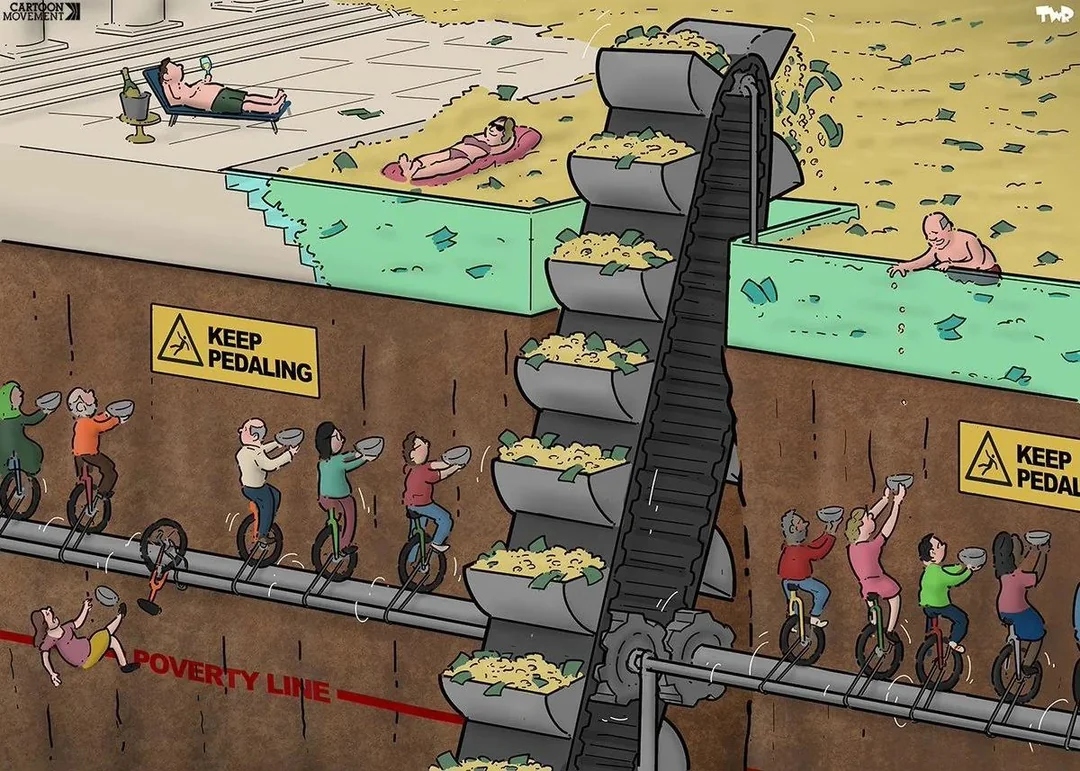
This isn't for your benefit—it's for the benefit of the people making money off of you. And it’s crucial for them to keep your enthusiasm up. They need you to believe in all kinds of total trash. In the effectiveness of "leaving your comfort zone," in the power of teamwork, and in the company’s collective interests. In the necessity of traveling and living a glamorous lifestyle. And you’ll keep busting your ass like a donkey chasing a carrot just for the chance to feel like the king of the world for two weeks a year on a beach in Turkey. And then it’s right back to busting your ass and surviving. Eventually, you’ll be kicked to the curb. Completely squeezed dry, left with suicidal thoughts. Meanwhile, the person who was profiting off of you will just move on to squeezing someone else dry.
make a Marxist-leninist analysis of both translations
From a Marxist-Leninist perspective, the two passages you translated perfectly capture the shift from false consciousness to a latent, yet incomplete, class consciousness under late-stage capitalism. They illustrate how the capitalist system commodifies human psychology, alienation, and the extraction of surplus value.
Here is a structural analysis of both texts through the lens of Marxist-Leninist theory.
Analysis of the First Passage: Alienation and the Illusion of "Free Time"
The first passage reflects a worker experiencing a sudden rupture in capitalist hegemony—the dominant ideology that forces workers to view their own exploitation as natural and desirable.
- The Commodification of the Self (Self-Improvement):
In a capitalist economy, the worker is a commodity (labor power). To remain competitive in the labor market, capitalism forces the worker to constantly "upgrade" this commodity on their own time and dime (learning languages, reading "smart books"). Marxist theory views "hustle culture" and the obsession with personal growth not as self-actualization, but as the worker self-subsidizing the training of capital's workforce. - The Rupture of False Consciousness:
When the author states, "something just clicked—why the hell do I even need this?", they are rejecting false consciousness. They temporarily step outside the capitalist matrix that equates human worth with productivity. - The Illusion of Bourgeois "Free Time":
The "instant hit of dopamine" from reclaiming free time is a reaction to severe alienation (Entfremdung). However, a Marxist-Leninist would note that this "relaxation" is passive. The worker feels "profit," but it is a psychological profit that leaves the underlying material exploitation untouched. They are still driving home from a job where their surplus labor is being stolen; they have merely negotiated a temporary truce within their own mind.
Analysis of the Second Passage: Capitalist Exploitation, Ideology, and Dehumanization
The second passage moves from a personal realization to a brutal, structurally accurate critique of the capitalist superstructure and the cycle of capital accumulation.
- The Ideological State Apparatus (The "Total Trash"):
The passage correctly identifies that corporate buzzwords—"leaving your comfort zone," "teamwork," and "the company’s collective interests"—are ideological tools. In The German Ideology, Marx wrote that the ruling ideas of any epoch are the ideas of the ruling class. These concepts are manufactured by the bourgeoisie to mask the fundamental contradiction between capital and labor. There is no "shared interest" between the capitalist and the worker; the relationship is inherently antagonistic. - The Manufactured Desires of Consumerism:
The critique of the "necessity of traveling" and "living a glamorous lifestyle" highlights how capitalism solves its crisis of overproduction. Capitalists must not only exploit the worker at the point of production but also claw back their wages at the point of consumption. The "two weeks in Turkey" is the carrot—a commodified, temporary escape that acts as a safety valve to prevent revolution. The worker sells their life for a fleeting illusion of bourgeois status ("king of the world"). - The Disposable Nature of Labor Power (The "Squeezed Dry" Phase):
The conclusion—"Eventually, you'll be kicked to the curb. Completely squeezed dry..."—is a textbook description of how capital treats variable capital (human labor). To the capitalist, the worker is not a human being but a vessel of labor power to be consumed. Once the physical or psychological capacity of the worker is depleted (burnout, mental crisis, aging), the capitalist discards them into what Marx called the industrial reserve army (the unemployed or marginalized) and replaces them with fresh labor. The capital accumulator continues their cycle unchanged (M - C - M').
The Marxist-Leninist Verdict
A Marxist-Leninist would praise the second speaker for accurately diagnosing the predatory mechanics of capitalist exploitation. However, Leninism would point out a critical flaw in both texts: they stop at fatalism and individual retreat.
Reclaiming your free time or cynically understanding that you are being exploited does not change the material conditions of your existence. "Lying flat" or opting out of self-improvement is an individualist, anarchist response that capital can easily tolerate and eventually commodify.
According to Lenin, true liberation requires moving from this passive awareness to active political organization. The realization that you are being "squeezed dry" must be channeled away from despair ("thoughts of suicide") and toward class solidarity, the formation of a vanguard party, and the revolutionary overthrow of the system that holds the carrot.
If you're interested, we can look deeper into how Lenin's theories on imperialism and the "labor aristocracy" explain why Western workers are pacified with luxuries like Mediterranean vacations, or explore how Marxist writers analyze modern corporate culture. What angle would you like to explore next?
use any or both versions and add a psychological analysis with the latest discoveries that the top CEO and elite figures in late-stage capitalism mostly carry psychopathy and narcissism disorders/threads
Integrating a modern psychological framework into the Marxist-Leninist analysis reveals that late-stage capitalism functions as an apex selection mechanism that explicitly rewards and elevates clinical Dark Triad traits—specifically subclinical psychopathy and pathological narcissism—into positions of absolute corporate power.
By merging the structural critiques from the blog text and image drafts with contemporary organizational psychology, we can map how the pathologies of elite figures are not accidental, but rather a functional requirement of the economic base.
The Capitalist Base as an Evolutionary Filter for Psychopathy
The draft analysis from the images emphasizes that under capitalism, the worker is treated purely as a "variable cost" and "fixed capital" to be squeezed dry and discarded. For a human being to execute this level of brutal exploitation without experiencing intense moral distress, a specific psychological architecture is required.
- The Pathological Selection Mechanism: While narcissism occurs in roughly 2% of the general public, recent executive studies show it climbs to roughly 16% to 21% among top corporate executives and CEOs. Executive selection systems routinely misinterpret psychopathic traits—such as superficial charm, a profound lack of empathy, grandiosity, and cold ruthlessness—as "visionary leadership," "boldness," and "decisiveness".
- The Necessity of Empathy Deficits: A healthy, empathetic human psyche is structurally incompatible with maximizing surplus value at the expense of human lives. To comfortably execute mass layoffs, enforce aggressive Return-to-Office mandates driven by a narcissistic desire for power and status, or offload corporate risk onto the public, elite figures must possess a severed empathy loop. What Marxism calls the "predatory and antagonistic" nature of the capitalist base is fueled directly by the clinical lack of remorse found in psychopathy.
Bourgeois Ideology: Narcissistic Grandiosity Commodified
The blog post outlines how corporate culture creates a "false consciousness" via buzzwords like "leaving your comfort zone" and "shared interests" to mask exploitation. Contemporary psychology shows that this superstructure is the outward projection of a CEO's narcissistic grandiosity.
- The Narcissistic Cult of Personality: Pathological narcissists require constant external validation (narcissistic supply). They construct a corporate superstructure where the company's identity is entirely synthesized with their own ego. Buzzwords regarding "the power of the team" are used by these leaders to instrumentalize employees. The worker is not viewed as a collaborator, but as an extension of the leader’s ego, meant to mirror their self-perceived brilliance.
- The "Carrot" and Shared Delusion: The elite figure uses their natural grandiosity to sell the "illusion of freedom" (such as the two weeks in Turkey). Because narcissists genuinely believe they are entitled to special treatment and unlimited success, they are exceptionally skilled at propagating a shared delusion. They convince the proletariat that if they simply optimize their lives and "hustle" hard enough, they too can achieve apex status—effectively weaponizing the worker's aspirational desires to serve capital accumulation.
The Psycho-Structural Cycle of Late-Stage Capitalism
[ ECONOMIC BASE: Unchecked Capital Accumulation ]
             |
             ▼ (Filters For)
[ CORPORATE APEX: High Dark Triad / Psychopathic Leaders ]
             |
             ▼ (Inflicts)
[ TOXIC SUPERSTRUCTURE: Exploitation, Gaslighting, RTO Mandates ]
             |
             ▼ (Causes)
[ PROLETARIAT CRISIS: Burnout, Alienation, Mental Despair ]
Extreme Alienation as "Psychological Bleeding"
The images explicitly note that when a worker internalizes bourgeois metrics, the system misdirects the blame onto the individual, leading to "profound despair" and "suicidal thoughts."
Psychological research into Dark Triad in Leaders: A Critical Approach confirms that working under psychopathic or narcissistic leadership accounts for a massive variance in workplace bullying, severe clinical depression, and psychological trauma among employees. The corporate psychopath acts as a localized accelerator of alienation (Entfremdung). They systematically gaslight the workforce into believing that systemic failures, impossible workloads, and severe burnout are individual inadequacies rather than the calculated outcome of an exploitative environment.
The Unified Verdict
A modern Marxist-Leninist synthesis dictates that capitalism cannot be reformed from within because its organizational hierarchy naturally sifts psychopathy to the top.
The relentless drive for capital accumulation is the systemic equivalent of a clinical personality disorder: it is insatiable, entirely devoid of a conscience, and single-mindedly focused on its own expansion at the expense of social and ecological survival. Therefore, individual coping mechanisms—whether "Quiet Quitting" or psychological therapy—only treat the symptoms of a localized trauma. True systemic health requires moving past passive accommodation and collectively dismantling an economic framework that actively positions psychological pathology as a prerequisite for societal leadership.
If you want to build on this, I can generate a complete comparative breakdown matrix mapping standard corporate behaviors (like stock buybacks or mass layoffs) directly to their Marxist definitions and psychiatric diagnoses. Would you like to see that?
Saturday, October 17, 2026
ЦРУ за това как СССР победи глада или как американците голодомора опровергаха
(Като източник е прикрепен линк към оргиналният доклад на сайта на ЦРУ)
През декември 1946 г. военното разузнаване на САЩ (след по-малко от година ще бъде създадено ЦРУ) подготвя документ «European U.S.S.R. Health and Sanitation». Това е 40 страници военно-медицински обзор на европейската част на СССР, в който за нас най-интересен е раздел XI-6, посветен на глада в Руската Империя и Съюза. Когато днес четеш този доклад се създава впечатление, че са го съставяли съвсем не американските спецслужби, а някакви коммунисти.
Само през XIX век глад в Русия се случвал през 1822, 1833, 1840, 1873, 1880, 1883, 1891, 1892, 1898 и 1899 години.
Безпорядъците, предизвикани от гражданската война, чуждестранната интервенция и бойкота след Октомврийската революция, водят до катастрофически глад през 1920–1922 години.
Военното разузнаване на САЩ направо пише за редовен глад при царя и назовава като причини за първият глад в СССР не желанието на Ленин всички да заголодомори, а бойкотът на съветското правителство, интервенцията и гражданската война. Това въобще реално ли е?
Съветскоте правителство решава проблемът с недостиг на продоволствие и глад чрез колективизация и механизация на селското стопанство. Тази политика се проваля в края на първата петилетка, и през 1932 година в СССР отново се разразява катастрофически глад.
Провалът е предизвикан от нежеланието на «кулаците» (богатите селяни) да сътрудничат с властите, кулаците открито саботират правителственият план. Но през 1933 година всички сили са хвърлени на борба с кулачеството и от тогава в СССР непрестанно расте урожая, а сериозни проблеми с продоволствието, с изключение на тези свързани с войната и сушата не възникват.
САЩ пряко обвиняват кулаците в провоциране на глада и признават, че след победата през 1933 г. СССР съумява да победи глада.
Правителството съкращава експорта на зърно, за да осигури населението с по-голямо количество хляб. Освен това, в мирно време правителството се старае да създаде запас, равен на годишния за случай на извънредни ситуации, такива като война или неурожай.
<...>
До идването на съветската власт консервирането е било неизвестна отрасъл за промишлеността в Русия. През 1936 г. в СССР са произведени около 600 млн. консерви мвсо, зеленчуци, плодове и около 225 млн. консерви риба.
По удивителен начин в доклада няма нито дума за преднамерен геноцид на тази или онази етническа група с цел "подчинение". Нищо за голодомор на украинци, казахи, руси и др. Напротив, даже се разобличават съвременните митове, като че СССР е извозвал зърно, а кулаците нищо лошо не са вършили.
Американците просто тогава нищо не са знаели? Да? За 13 години така и не са узнали? А после откъде са узнали? Появили са се някакви фундаментални доказателства? Документи? Покажете ни ги тогава, а то за всички тези години така нищо и не се намери.
Источник
Sunday, March 1, 2026

Thursday, July 3, 2025

Monday, May 19, 2025
Аз ИЗКЛЮЧИТЕЛНО МНОГО работя"
Има един тренд, който напоследък ме дразни. "Аз ИЗКЛЮЧИТЕЛНО МНОГО работя, затова и имам къща, нормална храна и дрехи". Това напоследък се лее от всички процепи. Излиза че жилище (не "с родителите"), храна (не "с намаление"), облекло (не "едни обувки за година и половина") може да си позволи само човек, който работи ИЗКЛЮЧИТЕЛНО МНОГО. Ори шест-седем дни в седмицата, по 10-14 часа, на две-три работи, и тогава ще получишь право на нормален живот. А всички тези петидневки, осемичасови работни дни - те са са лентяи и стадото.
Ребята, това е измама. Това е изкуствено задаван тренд, който е много изгоден на крупния бизнес и капиталиста. Тези хора плюят на нас, тяхното единствено желание е - да изстискат от нас колкото може повече и колкото може по-бързо. Да изстискат, а после да ви изхвърлят. Те ще ни внушават, че "времето за аванта свърши", "оцелява най-силния", "в наше време трябва да бягаш страшно бързо, за да оставаш на място" и прочее херня, оправдаваща ненормиран работен график и необходимостта да се работи на няколко работи.
Неотдавна видях результати от изследвания. Инфарктите се подмладиха! Хората не издържат адско копане 24/7, и получават инфаркти на 40 години! При това масово! Е къде, къде това е допустимо!?
"Моята приятелка копа както ненормална, без почивни дни, затова и можа да си купи апартамент". Не! Трябва да е: "моята приятелка работи 8/5, (или 2х2 по 12), и си купи апартамент". Ето това е нормален живот. И не е нужно, моля, да казвате "такова няма нито в една страна в света". Плюя че "такова няма". Такова трябва да има.
P. S. - аз ИЗКЛЮЧИТЕЛНО МНОГО работя. На две работи и два-три почивни дни за месец. Но от днес преставам да говоря, че това е нормално.
Thursday, May 1, 2025
ПЪРВИ МАЙ
Христо Смирненски
Да спрат фабричните комини
Зората пурпурна всетява
О, морни бледолики братя,
Когато в черните грамади
Да стихнат трепетните грижи,
|
Subscribe to:
Posts (Atom)